Table of Contents
Introduction
Creating activity books for Amazon KDP can take much more time than it first appears. A publisher may need to create puzzles, write instructions, prepare answer keys, format pages, check layouts, and finally export the interior in a suitable print format.
Memory Activity Prints is designed to simplify this process by bringing activity-page generation, editing, and print-ready exporting into one browser-based application.
But what exactly do Memory Activity Prints do? What templates are included? Is it suitable for beginners? And what should you know before using it for KDP publishing?
In this Memory Activity Prints review, we will look at its features, workflow, templates, pricing, commercial rights, pros and cons, and the type of users who may find it useful.
Note: This review is based on the product information provided on the official sales page. Features, pricing, template availability, and terms can change, so check the current sales page before purchasing.
Product Overview
| Product Name | Memory Activity Prints |
| Vendor | davidtran6 |
| Pricing | $19.00 |
| Official Website | www.memoryactivityprints.com |
| Bonuses | Access Your Bonuses |
| OTO’s | Yes |

What Are Memory Activity Prints?
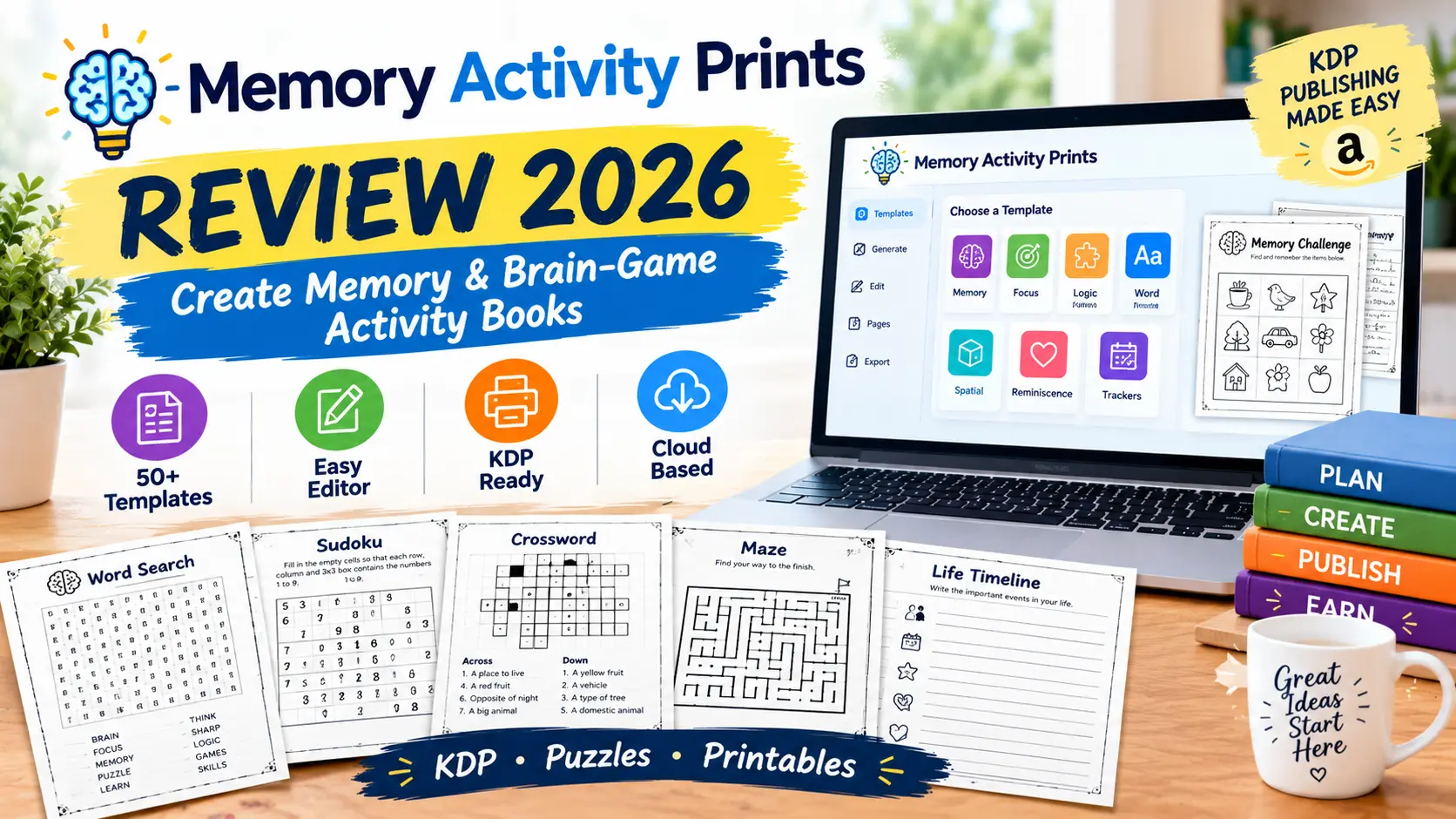
Memory Activity Prints is a cloud-based tool designed for creating memory, brain game, puzzle, and activity book pages.
According to the sales page, the platform includes more than 50 templates across seven categories. The templates can generate complete activity pages with instructions and, where applicable, answer keys.
The generated pages can then be edited inside a drag-and-drop workspace before being exported as PDF, JPG, or PNG files.
The tool is particularly positioned toward people creating activity books for platforms such as Amazon KDP, although the sales page also mentions other possible uses for the exported files.
How Do Memory Activity Prints Work?
The basic workflow is fairly straightforward.
Step 1: Choose a Template
Users can browse the available template library and select an activity or puzzle type.
The sales page lists categories such as
- Memory
- Focus
- Logic
- Word
- Spatial
- Reminiscence
- Trackers
Different templates can also have options such as difficulty, grid size, theme, and large-print settings.
Step 2: Generate the Page
After selecting the required settings, the tool generates the activity page.
Depending on the template, the generated page can include:
- Instructions
- Puzzle or activity
- Content
- Answer key
- Layout elements
Some word, story, trivia, and reminiscence templates are described as using freshly generated AI content.
Step 3: Edit the Page
Generated pages can be opened in the built-in editor.
The sales page describes this as a Canva-style, WYSIWYG editing environment. Users can work with text, shapes, images, layers, alignment tools, and page management options.
This means the generated page does not necessarily have to remain exactly as it was originally created.
Step 4: Export the Finished Book
Once the pages are ready, users can export their work.
The sales page states that the tool supports print-ready:
- JPG
- 300 DPI PNG
It also provides several KDP-standard page-size options with bleed and no-bleed settings.
However, publishers should still check Amazon KDP’s current requirements before uploading a final manuscript because marketplace specifications can change.
Key Features of Memory Activity Prints
50+ Activity Templates
One of the main features is the template library.
The sales page states that the complete library contains 50+ templates across seven categories, while the Starter plan includes 25 templates.
This can give publishers several different activity types to work with rather than creating every page from a blank document.
Memory Activity Templates
The Memory category includes activities designed around recall and remembering information.
Examples listed on the sales page include:
- Study & Recall Grid
- Sequence Recall
- Digit Span Ladder
- Story Recall
- Face-Name Association
- Shopping List Recall
- Memory Palace Builder
- What Changed Card
These templates can be combined when creating a varied activity workbook.
Focus Activities
The Focus category includes activities involving attention and visual scanning.
Examples include:
- Symbol Hunt
- Counting Streams
- Symbol-Digit Coding
- Trail Making A/B
- Stroop Sheet
- Dual Task Grid
The product page presents these as general activity pages rather than medical or diagnostic tools.
Logic Puzzles
For publishers who want more traditional puzzle content, the Logic category includes several options.
The listed templates include:
- Sudoku
- Cross Sums
- Math Cage
- Futoshiki
- Nonogram
- Hitori
- Shikaku
- Number Snake
- Magic Square
- Pattern Continuation
- Matrix Reasoning
- Mental Math Ladder
- Next Card
Some of these templates include automatically generated answer keys.
Word Games
The Word category provides several familiar activity formats.
Examples include:
- Word Search
- Crossword
- Cryptogram
- Anagram Sheet
- Missing Vowels
- Category Fluency
- First Letter Recall
- Word Ladder
The sales page indicates that some of these templates can generate fresh AI-written content.
It is still a good practice to review generated content and answer keys before publishing.
Spatial Activities
The spatial category focuses on visual and spatial activities.
The listed options include:
- Maze
- Mirror Draw
- Paper Folding
- Shape Rotation Match
- Follow the Route
- Grid Copy
These can add variety to an activity workbook instead of relying on only one puzzle format.
KDP-Oriented Export Options
Memory Activity Prints is also designed with KDP publishing workflows in mind.
According to the supplied product information, the platform includes:
- Eight KDP-standard page sizes
- Bleed and no-bleed options
- Trim guides
- PDF export
- JPG export
- 300 DPI PNG export
The sales page states that these options are designed around KDP’s published print specifications.
That does not mean every exported book will automatically be accepted by Amazon. Publishers are still responsible for checking the current KDP requirements, metadata, content, cover, margins, and other publishing details before submitting a book.
Commercial Rights
The sales page states that users receive full commercial rights, including PLR, to the content they create.
This is an important point for publishers who intend to use their generated pages commercially.
However, users should always read the current license terms before publishing or reselling content, particularly if the product’s terms change after purchase.
What Types of Books Can You Create?
Based on the listed templates, users can potentially create several different styles of activity workbooks.
For example, a publisher could combine memory exercises with:
- Logic puzzles
- Word games
- Spatial activities
- Trivia
- Reminiscence pages
- Focus exercises
- Tracking pages
This variety could be useful for creating themed or multi-section activity books.
A publisher could also create separate books around individual categories rather than putting everything into one workbook.
Memory Activity Prints Pricing
The supplied sales-page information lists a $19 one-time launch price, compared with a stated regular price of $97.
The page also says that launch pricing may change without notice.
The starter plan described on the page includes:
- 25 templates
- Templates from all seven categories
- Page generation
- Built-in design editor
- KDP-oriented export options
- Training videos
- Customer support
- Commercial rights
The page also mentions optional upgrades, so users should check exactly what is included in the current offer before purchasing.
Bonuses Included With Memory Activity Prints
The sales page lists several bonuses.
Bonus 1: Cryptogram Prints
A standalone cryptogram puzzle-book generator that can generate coded-quote puzzles and answer keys.
Bonus 2: Baby Boomer Crossword Prints
A standalone crossword generator focused on nostalgia themes associated with the 1950s through 1970s.
Bonus 3: Cross Sums Prints
A Cross Sums puzzle generator that includes answer keys.
Bonus 4: Copyright Page Templates
The package also includes eight fill-in-the-blank copyright-page templates designed for memory and brain-game activity books.
The sales page states a combined bonus value of $228, although buyers should focus on the actual features and usefulness of the included resources rather than the stated marketing value.
Who Is Memory Activity Prints Best For?
Memory Activity Prints may be useful for several types of users.
KDP Publishers
People who regularly create activity and puzzle books may appreciate having generation, editing, and export features in one application.
Beginners
The product is designed for users without advanced graphic-design experience.
The drag-and-drop editor and ready-made templates can provide a starting point for someone who does not want to build every page manually.
Activity Book Creators
If your main interest is creating memory, logic, word, or brain-game activity books, the template categories may provide a useful selection of formats.
Digital Product Sellers
The exported files may also be useful for sellers creating printable activity products for other platforms, subject to the product’s current license terms.
Pros and Cons of Memory Activity Prints
Pros
- Large collection of activity templates
- Seven different template categories
- Built-in page generation
- Automatic answer keys on applicable templates
- Drag-and-drop editor
- WYSIWYG editing
- Browser-based access
- KDP-oriented export options
- Multiple file formats
- Commercial rights stated on the sales page
- Beginner-friendly workflow
- Additional standalone puzzle-generator bonuses
Cons
- The Starter plan includes only part of the full template library
- Optional upgrades are mentioned
- Generated content should still be reviewed before publishing
- KDP acceptance cannot be guaranteed by any third-party tool
- Users still need to check current KDP publishing requirements
- The launch price may change
- The tool is focused mainly on activity and puzzle content rather than general book publishing
Is Memory Activity Prints Easy to Use?
The workflow described on the sales page is relatively simple:
Choose → Generate → Edit → Export
Users first choose a template, configure available options, generate a page, edit it inside the canvas, and then export the completed work.
For someone who normally creates every puzzle and page manually, this workflow can potentially reduce repetitive production work.
However, ease of use can vary from person to person. A new user may still need some time to understand the available templates and editing controls.
Important Things to Check Before Publishing
Even when a tool provides KDP-oriented export settings, publishers should not skip the final quality check.
Before uploading a book, check:
- Puzzle instructions
- Answer keys
- Spelling
- Trivia accuracy
- Page numbering
- Margins
- Bleed settings
- Trim size
- Image quality
- Blank pages
- Repeated content
- Copyright information
- Metadata
- Cover and interior consistency
AI-generated or automatically generated content should also be reviewed carefully.
A tool can speed up content creation, but the final quality check remains the publisher’s responsibility.
Frequently Asked Questions
1. What are Memory Activity Prints?
Memory Activity Prints is a browser-based application designed to generate, edit, and export memory, brain game, puzzle, and activity book pages.
2. Does the software need to be installed?
According to the supplied product information, Memory Activity Prints is cloud-based and works through a web browser.
3. Can I sell the books I create?
The sales page states that users receive full commercial rights, including PLR, to content they create. Users should review the current license terms for specific permitted uses.
4. Does it create answer keys?
The sales page states that applicable templates can automatically generate answer keys.
5. Does it create AI content?
The product page states that word, story, trivia, and reminiscence templates can use fresh AI-generated content.
6. Is memory activity a medical tool?
No. The sales page specifically states that Memory Activity Prints is for general recreational and educational use and is not a medical device or diagnostic tool.
Final Verdict
Memory Activity Prints is designed around a specific problem: creating varied memory and brain game activity pages can involve a lot of repetitive work.
Its approach is to bring template generation, page editing, answer keys, and print-oriented exporting into one browser-based workflow.
The combination of seven activity categories, 50+ templates in the full library, a WYSIWYG editor, KDP-oriented export settings, and commercial rights makes it particularly relevant to publishers who regularly create activity and puzzle books.
It is not a replacement for quality control, publishing knowledge, or marketplace research. Generated pages should still be checked carefully before they are published.
For beginners, KDP publishers, and activity-book creators who want a more structured production workflow, Memory Activity Prints is a tool worth examining based on the features described on its sales page.
Disclosure: This article is an independent informational review. Product features, pricing, bonuses, licenses, and availability may change. Please verify the current details on the official product page before making a purchase.
Medical disclaimer: Memory Activity Prints is described by its seller as a general recreational and educational activity tool. It should not be considered a medical device, diagnostic system, treatment, or substitute for professional medical advice.