Table of Contents
Introduction
Creating a book for Amazon KDP is easy to start, but finding a useful topic that is not simply another generic journal or low-content book can be more difficult.
This is where Meridian takes a different approach.
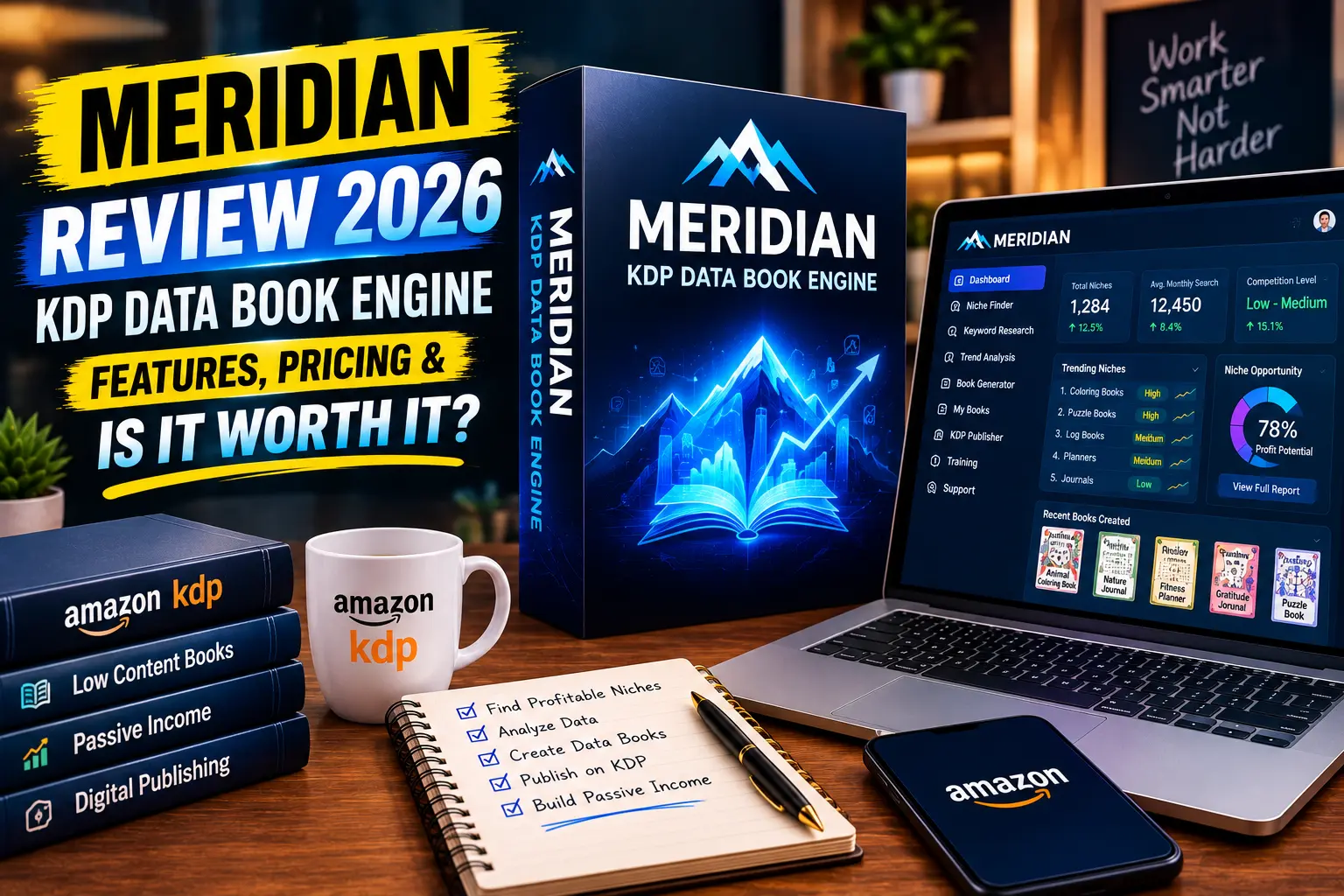
Instead of focusing on AI-written stories, generic journals, or prompt libraries, Meridian is presented as a data-book engine for KDP and printable publishers. It uses location-based data to create books around specific towns, years, and subjects.
The idea is interesting because the final product is based on computed data rather than ordinary AI-generated text.
In this Meridian Review 2026, we will look at what the platform does, how it works, its available templates, the town claiming system, languages, KDP features, pricing, limitations, pros and cons, and whether it may fit your publishing plans.
Product Details
| Product Name | Meridian |
| Vendor | thuthao0402 |
| Launch Date | 09/25/2026 |
| Launch Time | 09:00 AM (US Central Time) |
| Official Website | www.meridian.com |
| Bonuses | Access Your Bonuses |
| Pricing | $17.00 |
| OTO’s | Yes. |

What Is Meridian?
Meridian is a browser-based publishing tool designed around location-specific data books.
According to the supplied sales page, users can choose a niche, enter a town, and generate a print-ready book based on that specific location. The system is designed to calculate data for the selected place and package the result with a KDP-ready interior, cover, and listing information.
The product currently focuses on data-driven publishing niches such as
- Night sky
- Planting
- Weather
- Prayer times
- Fishing
- Tide information
- Golden hour
- Hunting solunar data
- Moon gardening
Some templates are included with the main offer, while others are listed as part of the Template Vault.
The important distinction is that Meridian is not positioned as a general AI book-writing tool.
It does not focus on generating stories or long-form AI articles. Instead, its core idea is to calculate and organize structured information for a particular location.
📊 How Does Meridian Work?
The workflow is designed around three basic steps.
Step 1: Choose a Niche and Town
You first choose the type of book you want to create.
Then you enter a town or location.
The sales page states that the platform supports more than 107,000 towns across 14 countries, with content available in five languages for supported editions.
For example, a publisher could create a night-sky book for a particular town rather than making a broad astronomy book for an entire country.
Step 2: Meridian Calculates the Data
After selecting the location and year, the engine calculates the relevant information.
Depending on the template, this may include things such as
- Moon phases
- Moonrise and moonset
- Sunrise and sunset
- Weather normals
- Frost dates
- Planting windows
- Prayer times
- Fishing periods
- Other location-specific information
The platform also handles timezone and daylight-saving calculations for supported books.
The sales page says the generation process takes about two minutes, although actual processing time can vary.
Step 3: Download the Publishing Package
Once the book is generated, the system provides a package intended for KDP publishing.
The listed output includes:
- 6×9 print-ready interior
- 140-page interior
- Matching full-wrap cover
- Listing copy
- 7 backend keywords
- Claim certificate
These files are provided together as a ZIP according to the sales material.
You would still be responsible for reviewing the material and following Amazon KDP’s current publishing requirements before uploading.
🚀 Meridian Features
Location-Specific Data Books
One of Meridian’s central features is its focus on individual locations.
Instead of producing one generic book about weather, astronomy, gardening, or fishing, the system is designed to generate an edition around a particular town.
This creates a more specific publishing concept than a standard generic book.
107,000+ Towns
The sales material states that Meridian supports more than 107,000 towns in 14 countries.
The listed countries include:
- United States
- Canada
- United Kingdom
- Ireland
- Australia
- New Zealand
- Germany
- Austria
- Switzerland
- France
- Belgium
- Spain
- Italy
- Mexico
Availability can depend on the particular template, so publishers should check the supported locations before creating a book.
Five Languages
Meridian supports five listed languages:
- English
- German
- French
- Spanish
- Italian
The sales page says the tables, instructions, covers, and listing copy can be provided in the selected language for supported world editions.
This could be useful for publishers who want to explore markets beyond English-language KDP.
However, if you do not understand the language you are publishing in, it is sensible to have a native speaker review the output before publishing. The vendor itself recommends this approach.
🌙 Available Meridian Book Templates
Meridian is not limited to one type of data book.
Night Sky Books
The Night Sky template includes information such as
- Moon phases
- Moonrise and moonset
- Dark-sky nights
- Meteor showers
It is positioned partly as a gift or keepsake-style book for a specific town.
🌱 When to Plant
The planting template provides frost-date information and growing-season guidance for 22 crops, using NOAA freeze-date normals for supported US locations.
This could be relevant to gardening-focused KDP publishers.
🌦️ The Weather Year
The Weather Year provides climate-normal information such as
- Normal high temperatures
- Normal low temperatures
- Rainfall
- Rain probability information
The sales page says this template uses the NOAA 1991–2020 Climate Normals.
One important limitation is that these are climate averages, not weather forecasts.
🕌 Prayer Times
The Prayer Times template calculates five daily prayer times based on the sun’s position.
The page says that six conventions are supported, including the UOIF convention for France and both Asr schools.
Because prayer-time conventions can differ between local authorities, users should verify that the selected calculation method is appropriate for their intended audience.
🎣 Solunar Fishing Calendar
The Solunar Fishing Calendar focuses on major and minor feeding periods and includes a fishing log.
It is listed as one of the front-end templates and is available for supported international locations.
🌊 Tide Log & Fishing Journal
The Tide Log template provides NOAA high- and low-tide information and a monthly tide curve.
This is part of the Template Vault rather than the five front-end templates. The sales material also states that it is US-only because it relies on US government data.
📸 Golden Hour Planner
Golden Hour Planner is designed around blue-hour and golden-hour windows for photographers.
It can be useful as a location-based photography planning book.
It is listed in the Template Vault.
🦌 Hunting Solunar Almanac
The Hunting Solunar template provides peak game-movement windows and a hunting log.
Like other specialized templates, users should understand the nature and limitations of the underlying calculations before publishing or using the information.
🌿 Moon Gardening Calendar
The Moon Gardening Calendar uses computed moon phases within a traditional four-quarter planting framework.
It is also listed as a Template Vault template.
📦 What Do You Get?
According to the supplied sales material, the launch offer includes:
- 5 front-end templates
- 107,000+ towns across 14 countries
- US National Edition
- 5 languages
- Past-year editions back to 1940
- 25 town claims
- 140-page print-ready interior
- Matching full-wrap cover
- Listing copy
- 7 keywords
- Claim certificate
- 3 interior themes
- Gift dedication pages
- Chart pages
The five front-end templates are Night Sky, When to Plant, The Weather Year, Prayer Times, and Solunar Fishing.
👥 Who Is Meridian Best For?
Meridian may be worth exploring if you:
- Already published on Amazon KDP
- Want to build a catalog rather than rely on one book
- Like data-driven publishing ideas
- Want location-specific book concepts
- Are interested in seasonal or recurring editions
- Want a ready-made interior and cover workflow
- Are comfortable reviewing data before publishing
- Want to explore international editions where supported
It may be particularly interesting for publishers who enjoy finding smaller niches rather than competing directly in broad categories.
Pros and Cons
✅ Pros
Location-Based Publishing
The focus on specific towns gives publishers a different approach from generic low-content books.
Real Computed Data
The product is built around structured calculations rather than relying primarily on AI-written text.
Multiple Niches
The available templates cover astronomy, gardening, weather, prayer times, fishing, and other specialized areas.
International Support
Several templates support multiple countries and five languages.
KDP Package
The interior, cover, and listing copy are designed to reduce the number of separate tools required.
Town Claiming
The server-side claiming system is intended to reduce duplicate Meridian-generated editions.
Past-Year Editions
The sales page says users can generate historical editions back to 1940, which can support keepsake-style book concepts.
⚠️ Cons
It Does Not Guarantee Sales
No location or niche is guaranteed to generate sales.
The vendor itself says that some towns may sell and others may not.
You Still Need to Publish
Meridian generates the publishing materials, but you are still responsible for reviewing them and publishing through your KDP account.
Some Templates Are US-Only
Several templates depend on NOAA data and are therefore restricted to US locations and English.
Weather Data Is Not a Forecast
The climate information represents long-term averages rather than a prediction of future weather.
The sales page explicitly points this out.
Prayer Times Can Vary
Different communities may use different calculation conventions.
The printed book cannot override the method used by a local religious authority.
Limited Front-End Claims
The front-end offer includes 25 town claims.
The vendor describes this as a limit intended to prevent early users from claiming large numbers of locations.
All Sales Are Final
There is no standard refund period according to the supplied sales page.
💰 Meridian Pricing
The supplied sales page lists a launch-week price of $17 as a one-time payment.
It also states that the offer has no subscription or recurring billing and that generated files remain with the user.
The page indicates that the price is expected to increase after the launch week.
Because launch pricing can change, readers should verify the actual price at checkout before purchasing.
Important: Refund Policy
The supplied sales page states that all sales are final.
That means buyers should carefully review the features, limitations, and current offer before placing an order.
Frequently Asked Questions
❓ What is Meridian?
Meridian is a browser-based data-book engine designed for KDP and printable publishers. It creates location-specific books using calculated data.
❓ How many towns does Meridian support?
The sales page states that more than 107,000 towns across 14 countries are supported.
❓ How many pages are the books?
The listed front-end output is a 140-page 6×9 print-ready interior.
❓ Does Meridian guarantee Amazon KDP sales?
No. The vendor explicitly says sales are not guaranteed.
❓ Is Meridian a subscription?
The supplied sales page describes the launch offer as a one-time payment with no recurring billing.
❓ Is there a refund?
The sales page states that all sales are final.
📝 Final Conclusion
Meridian Review 2026 shows a KDP tool with a somewhat different approach from the usual AI book generators.
Its focus is on location-based data books rather than AI-written stories.
The platform offers multiple templates, location-specific calculations, international support for selected templates, historical editions, town claiming, print-ready interiors, matching covers, and listing information.
The strongest part of the concept is its focus on specific locations and structured data. That gives publishers another way to think about KDP books beyond generic journals and simple AI-generated content.
However, there are important limitations.
Not every template works internationally. Weather information is based on climate normals rather than forecasts. Prayer-time calculations depend on the selected convention. The front-end offer has a 25-claim limit, and the vendor states that all sales are final.
Most importantly, Meridian does not guarantee sales or income.
For publishers who enjoy data-driven niches and are willing to build and manage a KDP catalog, Meridian may be an interesting tool to investigate.
For someone looking for a complete AI writing platform or guaranteed passive income, it is probably not the type of product being offered.
The best way to evaluate it is to treat Meridian as a book-production and data-calculation tool, then judge each niche and location on its own merits.