Table of Contents
Introduction
One of the perennial problems for independent authors is finding readers. Writing a book is only part of the process. Authors have to ensure their books are discoverable on search engines, online marketplaces, websites, social platforms, and other channels.
This problem is the basis for a marketing solution called Fiction Free Traffic. The sales page for the product says it helps fiction authors with keyword finding and generating content that’s optimised for search engines, AI-based search experiences, Amazon One of the perennial problems for independent authors is finding readers. Publishing a book is only half the battle. Authors need to ensure their books are searchable on search engines, online marketplaces, websites, social platforms, and other channels. discovery, and social media.
But is this really a good idea for an author who wants to improve their discoverability on the web? But is this really a good idea for an author who wants to improve their discoverability on the web?
In this review, we’ll look at what Fiction Free Traffic offers, how the workflow works, its main features, potential benefits, limitations, pricing information, and who may find it useful.
Disclosure: This article is an informational review. Disclosure: This article is an informational review. This website owner may earn an affiliate commission if you buy through a link on this page at no additional cost to you. This website owner may earn an affiliate commission if you buy through a link on this page at no additional cost to you. This has no bearing on the information or assessment given in this review. This has no bearing on the information or assessment given in this review.
Product Overview
| Product Name | Fiction Free Traffic |
| Vendor | kaysteve17 |
| Product Type | SEO & Content Creation Tool |
| Official Website | www.fictionfreetraffic.com |
| Bonuses | CLICK HERE |
| Pricing | $16.95 |
| OTO’s | Yes |
| Main Focus | SEO, content research and discoverability |

What Is Fiction Free Traffic?
Fiction Free Traffic is a marketing system for fiction authors focused on content and search.
The basic idea is quite simple: writers can create useful online content based on topics, genres, keywords, and questions that potential readers may search for, instead of relying only on paid advertising or social media promotion.
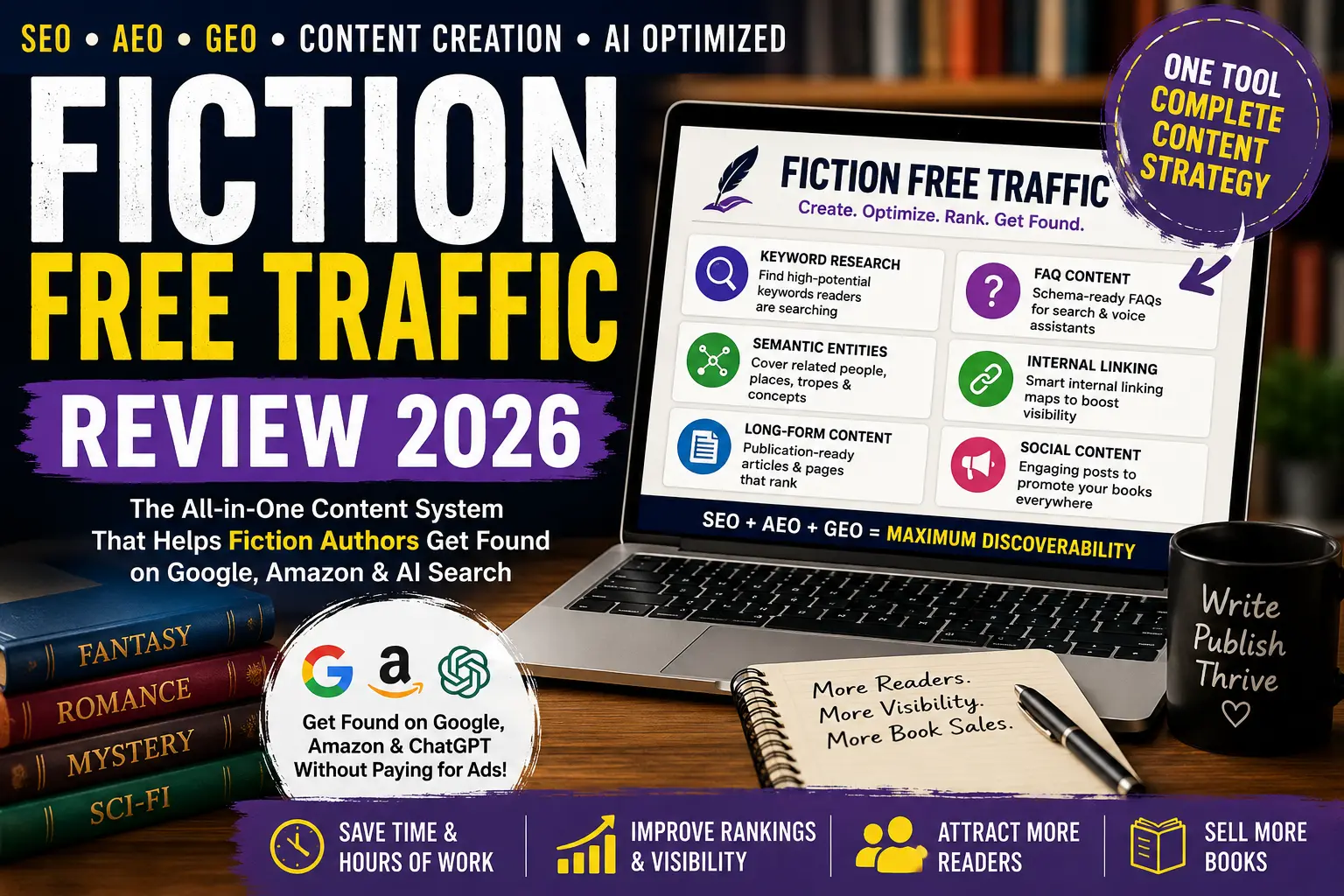
The sales page states that the user can enter a keyword, topic, product, service, or website and get a content package that may include keyword research, related concepts, long-form content, FAQ content, internal linking suggestions, social content, and multi-platform assets.
This makes the product feel more like a content production and discoverability workflow than a typical traffic generation service.
And that’s a huge difference.
The software can help you create and organize marketing material, but it does not guarantee that Google, Amazon, or any other platform will rank or recommend that content.
🚀 Key Features of Fiction Free Traffic
1. 🔎 Keyword Research
One of the main features is keyword research for fiction-related content.
The system is designed to identify phrases that readers and shoppers may use when searching for books or related topics. The supplied product information says the keywords are evaluated according to how realistic they may be to target for a particular book.
This can be useful because authors often know their genre very well but may not know exactly how potential readers phrase their searches.
2. 🧠 Semantic Entity Research
Modern search systems don’t rely only on one exact keyword.
Fiction Free Traffic also provides semantic entities related to the topic being researched. These can include related people, places, concepts, and genre elements.
For an author, this can help create content that covers a topic more naturally rather than repeatedly using the same keyword.
3. ✍️ Long-Form Content
The tool can produce structured long-form articles and pages based on the chosen topic.
The supplied material describes these as publication-ready content, although authors should still review and edit AI-assisted content before publishing it.
Human editing is particularly important for fiction-related websites because readers generally respond better to content that has a genuine author voice rather than generic text.
4. ❓ Schema-Ready FAQs
Fiction Free Traffic also includes FAQ-style content designed around direct questions and answers.
According to the product information, these FAQ blocks are structured with search and voice-assistant use cases in mind.
For an author website, FAQs can be useful for answering questions about genres, tropes, characters, reading order, book themes, and other reader interests.
5. 🔗 Internal Linking Maps
Another feature is an internal linking map.
Internal links connect related pages on your website. For example, a blog post about a particular fiction trope could link to a relevant book page, another related article, and an author’s series page.
The product is designed to suggest how these pieces of content can work together rather than treating every article as a standalone page.
⚙️ How Does Fiction Free Traffic Work?
The basic workflow can be understood in a few steps.
Step 1: Choose a Topic
Start with a book, genre, keyword, topic, or another relevant subject.
For example:
“Cozy mystery books for beginners”
The exact topic should be relevant to the author’s audience.
Step 2: Research the Topic
The system is designed to provide keyword and semantic research around the chosen subject.
This gives the author potential ideas for content.
Step 3: Create Content
The tool can generate content assets based on the research.
These may include articles, FAQ sections, social content, and other marketing material.
Step 4: Review and Customize
This step is particularly important.
Instead of publishing AI-generated content without checking it, authors should:
- Fact-check information
- Add personal experience where appropriate
- Remove unnecessary sections
- Improve examples
- Match their writing style
- Add original insights
- Make sure the content genuinely helps readers
Step 5: Publish and Promote
After editing, the content can be published on the author’s website or adapted for other platforms.
The sales page also describes multi-platform assets for places such as Amazon, blogs, and social platforms.
👥 Who Is Fiction Free Traffic Best For?
Fiction Free Traffic may be useful for:
Indie Fiction Authors
Authors managing their own websites and book promotion may benefit from having a structured content workflow.
Hybrid Authors
Authors who have publishing support but still manage part of their online visibility may also find the content tools useful.
Authors With Multiple Books
Authors with several books or a series may have more opportunities to create useful supporting content.
Beginner Authors
Someone unfamiliar with SEO and content planning may appreciate having keyword and content ideas organized into one workflow.
Authors Building a Website
If you’re developing an author website, the internal linking and content-generation features may help with planning your content structure.
💰 Fiction Free Traffic Pricing & What You Get
At the time of this review, the sales page displays a $16.95 one-time access price, reduced from a displayed $27 value. It also mentions that an ongoing plan may be available as an optional arrangement.
Because online product pricing can change, I recommend checking the current sales page before purchasing.
Another important point is the guarantee.
The sales page currently contains a placeholder for the guarantee period rather than a specific completed duration. Therefore, I would not state a specific money-back period in your article unless you verify the actual terms from the final checkout/purchase page.
✅ Fiction Free Traffic Pros & Cons
👍 Pros
Easy Starting Point
The software can reduce some of the manual work involved in creating an initial promotional page.
Beginner-Friendly Workflow
Users without advanced web design experience may find the simplified workflow easier than building pages completely from scratch.
Customization Options
Generated pages can be adjusted to match your branding and marketing approach.
Saves Setup Time
For marketers who regularly create similar promotional pages, automating the initial setup could reduce repetitive work.
👎 Cons
Generated Content Requires Review
AI-generated information should not be published blindly. Product claims, prices, features, and bonuses should be verified.
No Traffic Included
The tool creates pages; it does not provide a complete traffic-generation system.
Results Are Not Guaranteed
Creating a promotional page does not guarantee clicks, conversions, sales, or commissions.
❓ Frequently Asked Questions (FAQs)
1. What is fiction-free traffic?
Fiction Free Traffic is a marketing and content tool designed to help fiction authors with keyword research, content creation, FAQs, internal linking, social content, and other discoverability-related tasks.
2. Is Fiction Free Traffic an AI writing tool?
It includes AI-assisted content creation as part of its workflow. The sales page describes publication-ready long-form content, FAQs, social content, and other assets.
3. Can I use it if I already have a blog?
Yes. The sales page specifically says the system can work alongside an existing blog and provides internal linking suggestions for connecting new content with existing pages.
4. Does it replace an author website?
No. It is better viewed as a marketing and content workflow that can support an author website rather than replace the website itself.
5. Can beginners use Fiction Free Traffic?
The sales page states that no technical skill is required and describes the workflow as suitable for authors who want a simpler way to handle content and research.
6. Does it generate Amazon sales?
There is no basis to promise a specific number of Amazon sales from using the software.
It may provide Amazon-focused keyword research and related assets, but sales depend on many factors beyond the tool.
⭐ Final Conclusion
Fiction Free Traffic takes an interesting approach to author marketing by bringing keyword research, content creation, FAQ development, internal linking, and social content into one workflow.
Its biggest potential advantage is convenience. Instead of using several separate tools to research topics and plan content, authors can use one system to create a starting point for their marketing materials.
However, it’s important to keep expectations realistic.
Fiction Free Traffic is not a guaranteed source of Google traffic, Amazon sales, or AI recommendations. Search visibility cannot be guaranteed by any single content tool.
The best way to use a system like this is as a research and content-production assistant, not as a replacement for an author’s own judgment.
Before publishing generated content, add your own perspective, examples, experience, and useful information. That approach can make the content more valuable to readers and create a stronger long-term website.